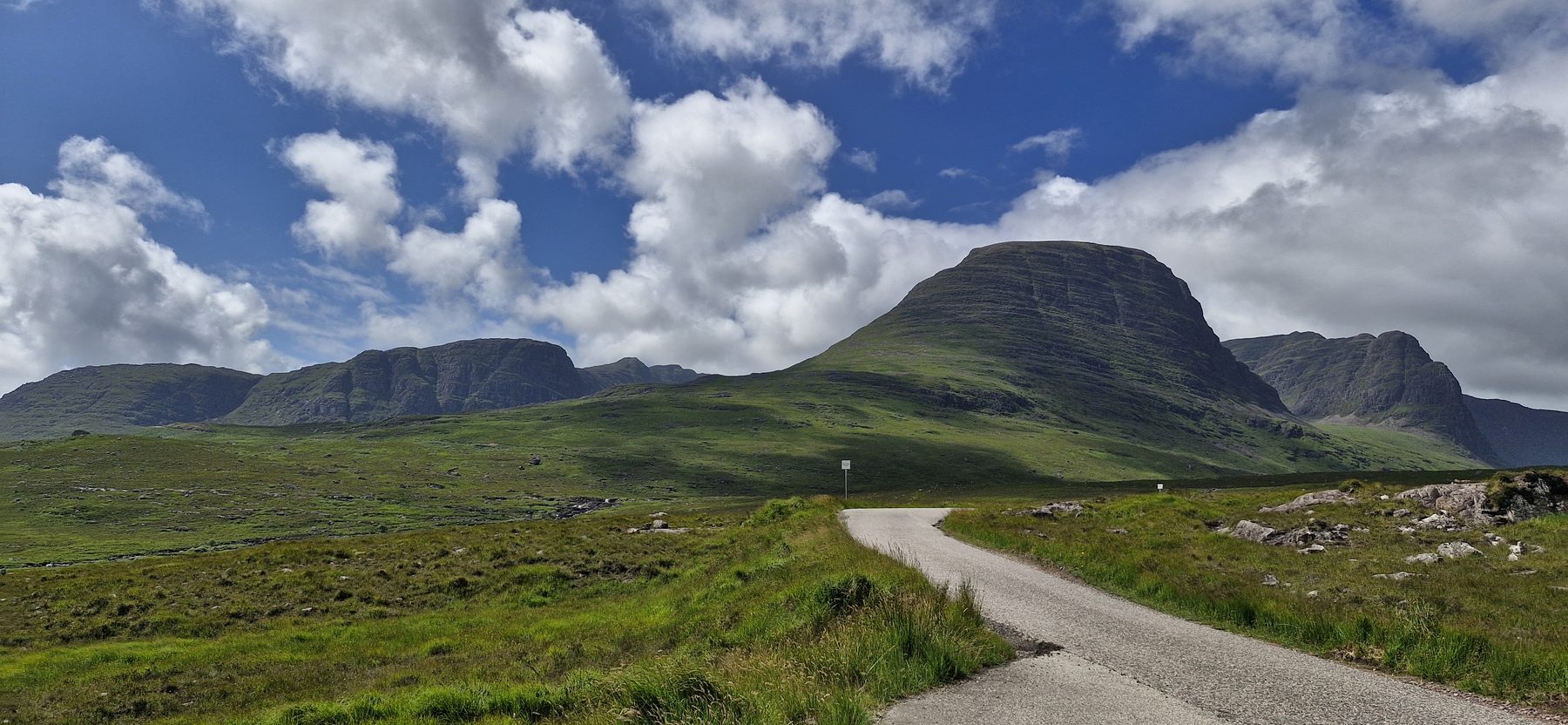
I've decided that I want to climb the Munros.
It is a goal that has been sitting in the back of my mind for a while, and the more I think about it, the more excited I become about the idea of exploring Scotland's mountains one summit at a time.
But I'm also realistic.
Climbing a Munro isn't simply about being able to walk. There is a difference between going for a comfortable walk on a relatively flat trail and spending several hours gaining hundreds of metres of elevation, dealing with steep ground, uneven terrain, changing weather and the mental challenge of knowing that you still have to get back down again.
So rather than jumping straight into the hardest mountain I can find, I'm going to work towards it.
My plan is to hike regularly, build up my distance and elevation gradually, and use those walks to find out what my body can actually handle. I want to build the fitness and endurance, but I also want to build confidence.
What exactly is a Munro?
A Munro is a Scottish mountain with a height of at least 3,000 feet, or 914.4 metres, and enough separation from neighbouring summits to be considered a separate mountain.
There are currently 282 Munros in Scotland. The list was originally created by Sir Hugh Munro and first published in 1891. The Scottish Mountaineering Club maintains the official list.
That means there aren't simply 282 mountains that are all roughly the same difficulty.
Far from it.
The Munros are spread across Scotland and vary enormously in height, distance, terrain, exposure and difficulty. Some can be approached on relatively straightforward paths, while others involve rough ground, steep slopes, ridges or sections where there isn't a clearly defined path to follow.
There isn't one 'Munro fitness level'
One of the things I think is important to understand when starting out is that there isn't a single fitness level that makes someone 'ready' for the Munros.
Being able to walk for a certain number of miles doesn't automatically mean you're ready for every Munro. Equally, you don't have to be an incredibly fit athlete before you're allowed to start climbing them.
What matters is gradually developing the ability to walk for several hours, cope with sustained uphill sections, manage uneven ground and still have enough energy left to get safely back down.
That's why I'm starting with hiking trails.
I want to increase my walking distance gradually. I also want to introduce more elevation into my walks, because walking five or six miles on relatively flat ground is very different from walking five or six miles while constantly climbing.
Over time, I'll be able to see how my body responds to longer walks, steeper climbs and bigger days on my feet.
It's okay to turn back
This is probably one of the biggest things I want to remind myself as I start this journey.
Reaching the summit isn't more important than getting home safely.
If I attempt a Munro and realise that I'm not ready for it, turning around isn't failing.
If I get halfway up and my legs are exhausted, the weather changes, I lose confidence or I simply decide that I've had enough for the day, I can turn back.
And I can try again another time.
In fact, I think there is something really valuable about approaching Munro walking this way. The first few mountains don't have to be about collecting ticks. They can be about learning.
Learning how my body handles elevation. Learning how long different distances take me. Learning how much food and water I need. Learning how weather affects the mountain. Learning how to pace myself.
Mountaineering Scotland recommends taking a progressive approach to hillwalking, building fitness, stamina, experience and confidence rather than immediately tackling something beyond your current ability.
Not every Munro is the same distance
One of the things that makes the Munros so interesting is the variation between them.
There isn't a standard Munro route that says, for example, 'walk ten miles and climb 900 metres'. Every mountain is different.
Some routes may involve a relatively short walk to the summit but a significant amount of ascent. Others can involve many miles of walking before you even reach the final climb.
There can also be a huge difference in how much elevation you gain from the starting point to the summit. Remember, the mountain's height above sea level isn't the same thing as the amount you have to climb.
A mountain might be over 1,000 metres high but your route could start much higher up, while another route could begin much closer to sea level. The total ascent is therefore just as important as the summit height when you're working out how demanding a day could be.
For someone preparing for their first Munros, this is one of the reasons I want to pay attention to distance, elevation and time on my feet, rather than simply counting miles.
Some Munros have paths. Some don't.
Another thing I'm learning is that a Munro isn't necessarily a mountain with a nice, obvious path all the way to the top.
Some popular routes have well-established paths for much of the journey. Others can become much rougher, less obvious or more challenging as you gain height.
In some areas there may be sections where there is no clearly defined path at all.
That means hiking isn't just about fitness.
Navigation and mountain awareness matter too.
Forestry and Land Scotland also points out that paths aren't always easy to follow in the hills and that some areas have no waymarkers or signposts once you're away from established trails.
As I progress towards the Munros, I want to become increasingly comfortable with reading routes, understanding where I'm going and not relying entirely on my phone to tell me where I am.
Building up before tackling the mountains
For me, the preparation is going to be part of the adventure.
I'll be using ordinary hiking trails to gradually build my endurance. I'll start with distances that feel manageable and then increase them as my fitness improves.
I'll also look for routes with more elevation, because climbing uphill is something I need to become comfortable with.
Eventually, I want to be able to spend a good number of hours walking without feeling completely exhausted. I want to know that I can climb, descend and still have enough energy to deal with whatever the trail throws at me.
I'm not trying to become a runner or spend hours in a gym.
I'm training for the activity I actually want to do: walking in the mountains.
Safety has to come first
Mountain walking is an amazing way to explore Scotland, but the mountains deserve respect.
Before setting off, I need to check the route, check the mountain weather, make sure someone knows where I'm going and carry appropriate clothing, food, water and safety equipment.
A map and compass are important, and I need to know how to use them rather than relying solely on a phone or GPS. A waterproof jacket and trousers, warm layers, suitable footwear, a torch, first-aid supplies, navigation equipment and emergency equipment should all form part of proper preparation.
And perhaps most importantly, I need to be prepared to change my plans.
Turning back isn't a weakness. It's part of mountain safety.
The weather can change everything
Scottish mountain weather can be completely different from the weather at the bottom of the mountain.
A day that starts warm and sunny can become cold, wet, windy or foggy higher up. Visibility can also change quickly, making navigation much more difficult.
Scottish Mountain Rescue warns that conditions in the mountains can change very quickly and that the weather on the hill can be very different from conditions at the roadside.
That's another reason I don't want to treat a weather forecast as a guarantee.
I'll check the forecast before setting off, but I'll also pay attention to what's happening around me while I'm actually on the hill.
If the conditions become unsafe, the plan changes.
One Munro doesn't always mean one mountain in a day
Something else I've discovered while looking into Munro walking is that you don't always have to climb one mountain and go home.
Some Munros are located close together and can be linked together into one longer route. This means that, on the right route and with the right level of fitness and experience, it can be possible to climb two or more Munros in a single day.
That can turn a single mountain day into a much bigger adventure.
Of course, this also means more distance, more ascent and more time on the hill. A route that includes three Munros isn't simply 'three small walks'. It can become a very long and demanding day.
That's something I don't need to worry about at the beginning.
First, I want to be comfortable completing one mountain.
Then, when my fitness, confidence and experience have developed, I can start looking at routes where multiple Munros can be linked together.
This is where my Munro journey starts
I'm not setting myself the goal of climbing all 282 Munros as quickly as possible.
Maybe one day I'll want to say I've climbed them all. Maybe I'll simply enjoy choosing mountains that look interesting and exploring them at my own pace.
Right now, my goal is much simpler.
I want to become fit enough, strong enough and confident enough to stand at the bottom of a Munro and think, 'I can give this a go.'
That means hiking.
It means increasing my distance.
It means climbing more elevation.
It means learning about navigation and mountain safety.
It means understanding that turning around is sometimes the right decision.
And it means enjoying the journey towards the mountains rather than thinking that the journey only starts when I reach my first summit.
So that's where I'm starting.
One trail at a time. One hill at a time. One step closer to the Munros.