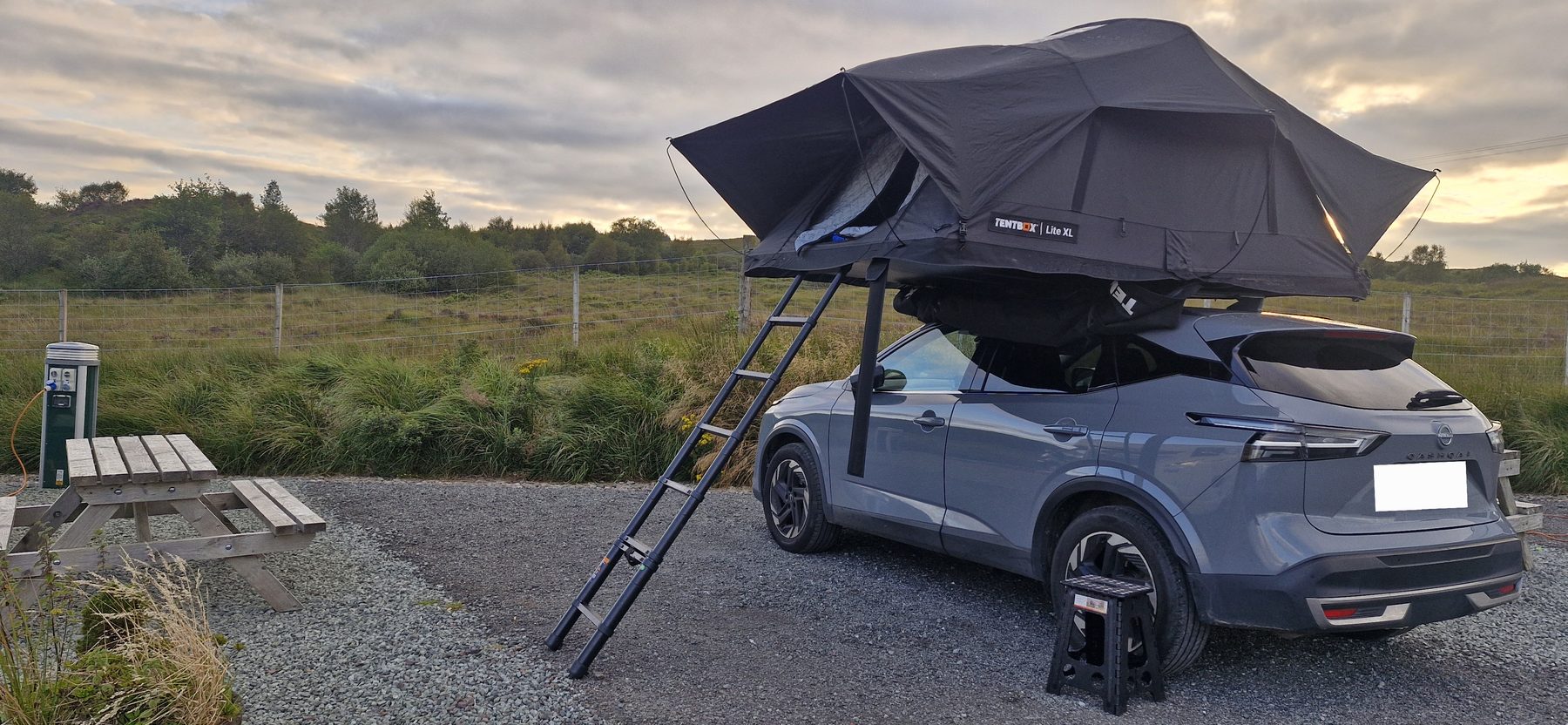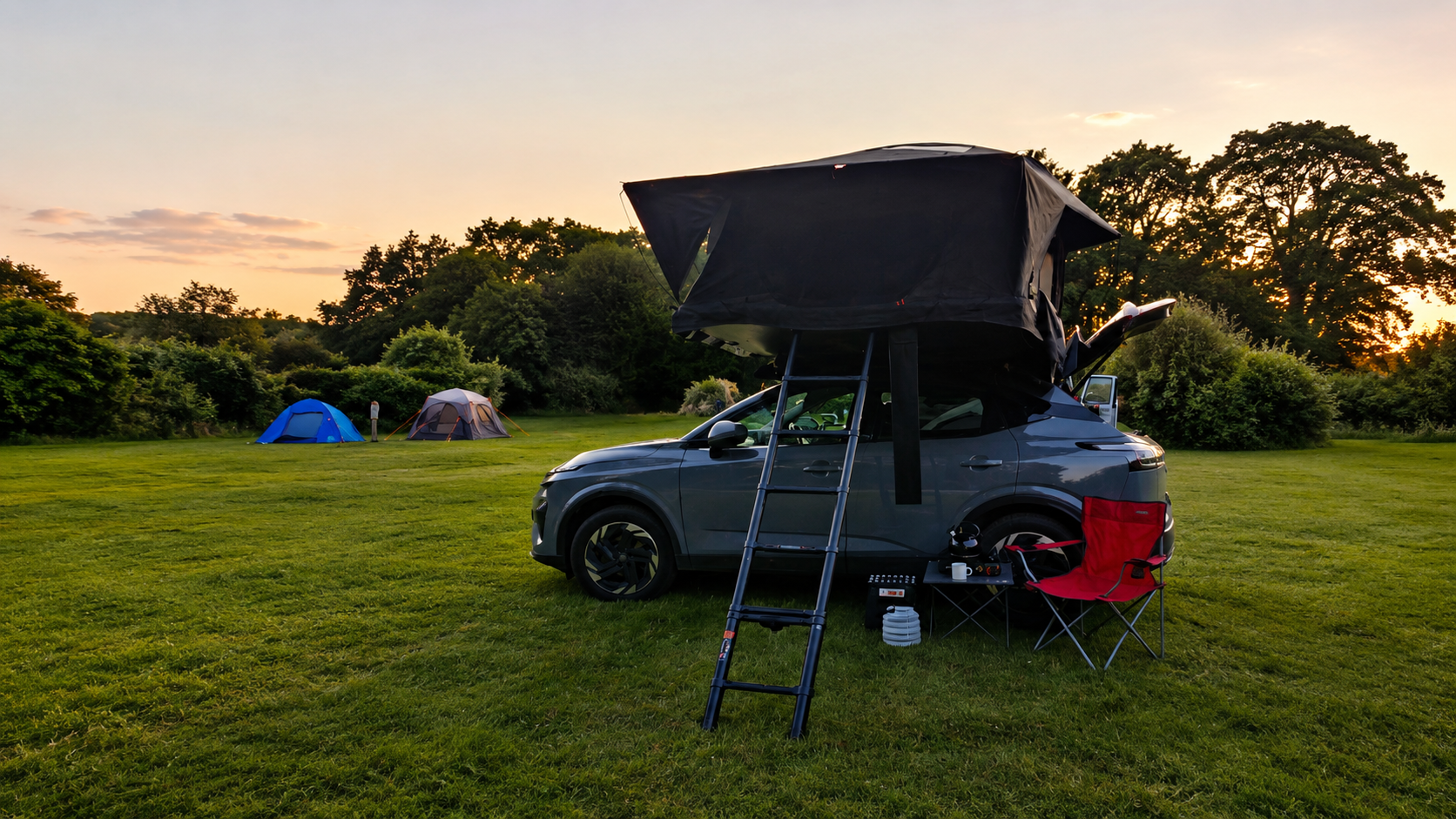
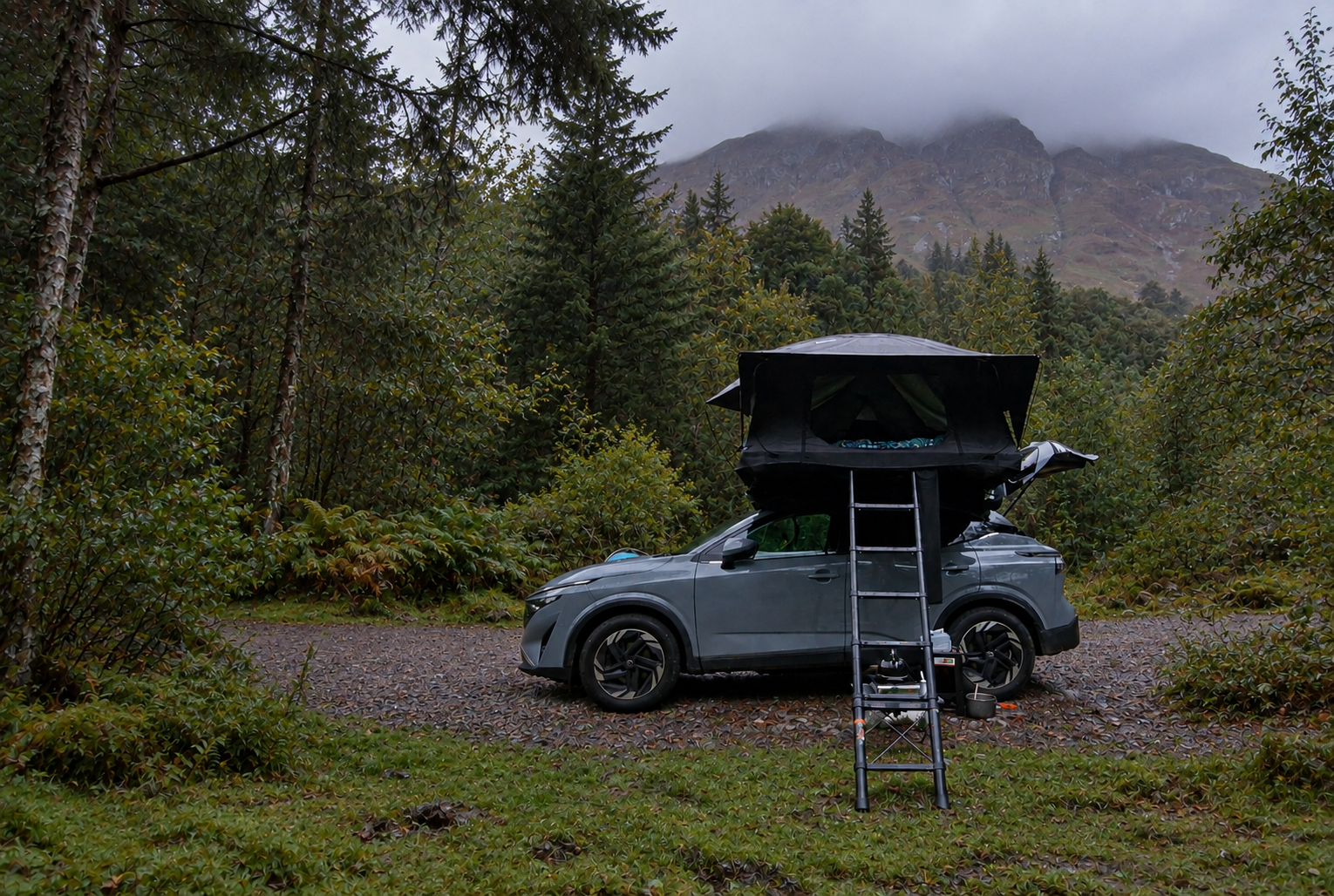
There are some nights camping that you remember because of the views.
Some because of the weather.
And then there are the nights that you remember because, for a few hours, you had absolutely no idea what was going to happen next.
This was one of those nights.
It had been a lovely evening. Dry, warm and calm. The sort of night that makes camping feel like the best idea in the world.
I was tucked up in my TentBox, high above the ground and surrounded by pine forest. The skylight was open and I could look up into the darkness and see the night sky above me.
Earlier that evening, I'd been on the phone to a friend when they casually mentioned there could be some thunder and lightning.
Thunder and lightning?
I immediately opened my weather app.
Nothing.
No mention of thunderstorms. No obvious warning about lightning. Nothing that made me think I should change my plans.
So I carried on with my evening.
I had dinner, made myself a cup of tea and got cosy in the TentBox. I had my book ready and settled down for the night, surrounded by trees with nothing but the sounds of the forest around me.
Eventually, I fell asleep.
And then, at around 2am, I woke up.
BOOM.
A loud noise.
When you're camping alone, surrounded by a forest, there is something very unsettling about suddenly waking up to a noise you weren't expecting.
My eyes shot open.
I froze.
I listened.
And then the sky lit up.
A huge flash of bright white light filled the darkness.
My eyes went wide.
Then the panic set in.
What do I do now?
I lay there listening.
Another flash.
Then thunder.
Another flash.
More thunder.
And suddenly the peaceful little camping trip I'd gone to sleep enjoying felt very different.
There is something both terrifying and mesmerising about watching lightning from a TentBox at night.
The whole sky would suddenly illuminate, almost as though someone had switched the lights on across the forest. Then everything would disappear back into darkness before another flash arrived.
And there I was, lying in a little tent on top of my car.
In a pine forest.
Alone.
During a thunderstorm.
Not exactly where I'd choose to be if I had known what was coming.
And I was definitely glad my kids weren't with me at that point.
I remember thinking that I was probably in one of the worst possible spots for a thunderstorm. I was elevated above the ground, surrounded by trees, and sleeping in something that was very much a tent rather than a building.
But I also thought the storm seemed to be some distance away.
The flashes were spectacular, but there was a noticeable gap between seeing them and hearing the thunder.
So I decided to stay put.
I lay there watching.
Every so often, the sky would light up again.
It was frightening.
But it was also incredible.
Eventually, the storm moved on and the night became quiet again.
What should I actually have done?
Afterwards I couldn't stop thinking about it.
Because this is one of those situations where you can be an experienced camper and still suddenly find yourself wondering what the correct decision is.
If I'd known a thunderstorm was coming, I could have closed the TentBox, climbed down, got into the car and driven somewhere safer.
But what if you're already asleep?
What if you wake up to thunder and lightning?
What if you're in a normal ground tent?
And how do you even know how close the storm actually is?
So I decided to find out.
How do you know how far away the lightning is?
One thing I'd always remembered from somewhere was that you could work out roughly how far away a storm was by counting between the lightning and the thunder.
And that part is actually right.
You see the flash of lightning first, then count the seconds until you hear the thunder.
The reason this works is that the flash reaches you almost instantly, while the sound of the thunder takes much longer to travel.
- 3 seconds = about 1 km away
- 6 seconds = about 2 km away
- 15 seconds = about 5 km away
- 30 seconds = about 10 km away
So if you see lightning, count “one… two… three…” and then hear the thunder, the storm is roughly 1 kilometre away.
If the gap between the flash and the thunder gets shorter, the storm is getting closer.
If the gap gets longer, it's moving away.
But there is an important point I didn't realise at the time.
Being able to work out roughly how far away the storm is doesn't mean you can assume you're safe.
If you can hear thunder, the storm is close enough for lightning to be a potential danger. The distance calculation is useful for understanding what the storm is doing, but it shouldn't be used as a reason to stay outside or remain in an unsafe shelter.
So what should I have done in my TentBox?
This was the bit that surprised me when I started looking into it.
I'd assumed that because my TentBox was attached to the car, there might be some protection from being up there.
There isn't.
A TentBox is still a tent. Being attached to a vehicle doesn't turn it into a lightning-safe shelter.
TentBox themselves advise that their roof tents do not provide lightning protection.
The safer place would have been inside the car.
So, if I'd known before going to sleep that thunderstorms were likely, the sensible option would have been to pack away the TentBox and sleep somewhere safer.
But what about waking up in the middle of the night, like I did?
If it was safe to do so, the better option would have been to get down from the TentBox and get inside the car.
The car itself provides considerably better protection during a lightning storm than a tent. The metal structure of the vehicle provides a path for the electrical current around the occupants rather than through them.
It's the car that provides the protection — not the TentBox sitting on top of it.
What about a normal ground tent?
Unfortunately, a ground tent isn't considered safe shelter from lightning either.
If you're camping in a normal tent and a thunderstorm develops, the safest option is to leave the tent and get into a suitable enclosed shelter, preferably a substantial building or your vehicle.
If you're camping somewhere remote and there is genuinely no vehicle or building nearby, things become more difficult.
The aim is to reduce your risk as much as possible.
Move away from exposed high ground, isolated trees, water and other potentially dangerous objects.
If there is no safe shelter available, move towards lower ground and minimise your contact with the ground. Don't lie flat.
It's not perfect protection, but it can reduce the risk while you wait for the storm to pass.
And when is it safe to go back?
This was another thing I hadn't really thought about.
A storm doesn't necessarily become safe the moment the rain stops or the sky looks calmer.
The advice is to wait at least 30 minutes after the last thunder before leaving your shelter.
So if you're sitting in your car watching the storm pass, don't jump straight back into your tent because you haven't heard anything for five minutes.
Wait.
The storm can still be dangerous even when it appears to be moving away.
Would I intentionally camp in a thunderstorm?
Absolutely not.
I'm quite happy camping in rain.
I'm quite happy camping in wind.
I'm even quite happy waking up in the middle of the night because the weather has decided to throw everything at my TentBox.
But deliberately choosing a camping spot when thunderstorms are forecast?
No thanks.
What made this night particularly memorable was that I hadn't gone to sleep expecting a storm.
I'd checked the weather.
I'd looked at the forecast.
I'd settled down expecting a warm, dry night under the stars.
Instead, I woke up at 2am with the sky flashing above me.
And although I stayed where I was that night, having now looked properly into the advice, I know what I'd do differently next time.
- TentBox? Get into the car.
- Ground tent? Get into the car.
- No vehicle or building nearby? Get to lower ground, away from trees and exposed objects, and minimise contact with the ground while you wait it out.
And most importantly, don't rely on counting the seconds between lightning and thunder to decide whether you're safe.
Use it to understand how far away the storm is and whether that gap is changing — but once you can hear thunder, take the storm seriously.
Because as beautiful as that night was, there was something slightly surreal about lying in a tiny tent, elevated above a forest, watching the entire sky light up around me.
It was terrifying.
It was mesmerising.
And it is definitely a night of camping that I'll never forget.